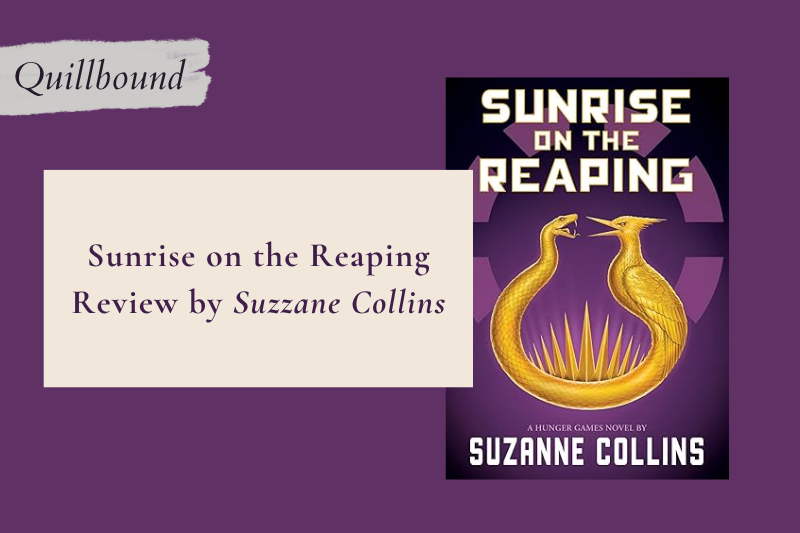
More than a decade after the original Hunger Games trilogy reshaped modern dystopian fiction, Suzanne Collins pulls us back into the arena. This time, it’s not Katniss Everdeen’s mockingjay cry that echoes in our ears. In Sunrise on the Reaping, we return to a grimmer and more politically volatile Panem, a nation still licking its wounds and sharpening its blades.
Set 24 years before the events of The Hunger Games, this prequel takes us to the 50th Hunger Games, also known as the Second Quarter Quell. For longtime fans, this is the Victor’s Games, the one where Haymitch Abernathy carved his name into the Capitol’s memory. Collins delivers a raw, haunting, and politically charged narrative that expands the mythology and adds new emotional weight to familiar history.
Welcome Back to the Nightmare
Where The Ballad of Songbirds and Snakes explored the twisted origins of the Games, Sunrise on the Reaping drops us into a system that has already mastered cruelty. The Games are no longer an experiment; they have become a fully developed engine of terror. The Capitol is more extravagant, more callous, and even more calculated in its manipulation.
Collins writes with clarity and depth, offering a world that is terrifying yet disturbingly recognizable. She forces us to examine power, spectacle, and survival from a new perspective, even after all these years.
Haymitch Abernathy: More Than a Bitter Mentor
This is Haymitch’s story, and for those who only knew him as the sharp-tongued alcoholic from District 12, the novel is a revelation.
Here, Haymitch is 16 years old, clever, loyal, and already carrying more than his share of burdens. Watching him maneuver through the Capitol’s politics and the deadly arena shows us just how deep his scars go. Collins lets us see the grief, fear, and brilliance behind his sarcastic shell.
One of the most impactful lines comes mid-Games, as Haymitch reflects:
“Survival isn’t victory. It’s just living long enough to remember what it cost.”
That single sentence captures the heart of this novel and everything the Hunger Games universe has stood for since day one.
The Quarter Quell Like Never Before
This particular Games is brutal and unforgettable. The twist, doubling the number of tributes, makes the arena more chaotic and the odds more unforgiving. Collins does not rush the horror. Instead, she lets the dread build slowly, immersing us in the strategic cruelty that defines the Quarter Quell.
Haymitch’s journey inside the arena is full of tension and impossible choices. Without giving too much away, the tactics he uses and the losses he endures reshape everything we thought we knew about him.
Themes That Feel All Too Real
What elevates this prequel is not just its violence or lore but its urgent message. Collins is not just writing a dystopia for escapism. She is asking us to think.
The book examines how systems exploit the young, how violence is turned into entertainment, and how resistance often comes at a devastating cost. The Capitol’s obsession with pain and spectacle reflects far too much of our current reality.
Final Thoughts
Sunrise on the Reaping is a prequel that matters. It enriches the original trilogy, adds new layers to a complex and beloved character, and presents timely questions about justice, memory, and resistance.
It is darker and more emotionally nuanced than its predecessors, but it holds the same gripping power that first drew us into Panem.
Rating: 4 out of 5
Recommended for:
- Fans who want to see the history that shaped Haymitch
- Readers who crave high-stakes storytelling with emotional complexity
- Anyone ready to return to Panem, even if it means being torn apart all over again
This book does not just revisit old ground. It digs deeper, and it leaves a scar you will not soon forget.
Leave a Reply